Washington State University, School of the Environment
Graduate Student Handbook
[Updated July 2026]
Handbook Overview
Welcome to the Graduate Handbook for the Washington State University (WSU) School of the Environment. This handbook is intended to help you make the most of your experience as a graduate student, to familiarize you with policies and procedures of the program, and to clarify expectations.
The information contained in this handbook is based on School of the Environment program policies and the WSU Graduate School policies. However, requirements and procedures change periodically, so check the School of the Environment and the WSU Graduate School websites regularly to ensure that you are following the most up-to-date procedures.
Notice of Nondiscrimination
Please visit Washington State University’s (WSU) Notice of Nondiscrimination web page for more information. Everything there applies to all WSU graduate students.
A Statement from the Associate Director of Graduate Studies
Welcome to the School of the Environment at Washington State University.
The School of the Environment (SOE) is jointly administered by the WSU College of Arts and Sciences (CAS) and the College of Agricultural, Human, and Natural Resource Sciences (CAHNRS). Our academic unit includes faculty, students, and staff at multiple campuses, as well as research centers across the WSU system & state.
This handbook outlines the policies and procedures for our graduate programs. It also contains essential information specific to graduate studies within the SOE and general information of interest to all WSU graduate students.
Although we regularly update the handbook, it is not meant to be all-inclusive. More detailed information may be accessed in the Graduate School Policies & Procedures manual, campus-specific resources, and members of faculty and staff including the campus graduate academic coordinator for our department, your advisor, and myself.
An important part of the SOE graduate mission is to provide world class graduate education in geosciences, wildlife ecology, natural resource sciences, forestry, and environmental sciences. Graduate students are centrally and crucially important to SOE in research, teaching and maintaining a vibrant academic community. We welcome your participation.
Sincerely,
Dan Thornton
Associate Professor & Associate Director of Graduate Studies
Pullman, Puyallup, Tri-Cities, and Vancouver Campuses
About the School
Our Mission
The School of the Environment (SOE) supports the mission of Washington State University as a major land-grant research institution. Our teaching, research, and outreach advances understanding of the Earth’s complex and dynamic physical, structural, biogeochemical, ecological, and biological systems, and effects of land use and climate change. We advance scientific and social innovations needed to conserve biological diversity and to promote productive and sustainable ecological and human communities.
Through our academics and research, SOE aims to:
- Generate fundamental knowledge about environmental and ecological processes, natural resources, human-environment interactions, and the Earth.
- Develop solutions to environmental problems at the state, national, and global levels.
- Provide cutting-edge training to the next generation of research scientists, environmental and natural resource managers, environmental leaders, policy makers and global citizens.
- Facilitate the integrated research and education necessary to support the Land Grant mission to achieve a sustainable future.
- Promote the long-term conservation and enhancement of biological diversity and natural resources in an ecologically sustainable manner.
Graduate Degrees
The School of the Environment offers several degree programs that cover a broad range of Earth & environmental sciences.
The SOE currently offers two (2) Master of Science (MS) degree programs:
- MS in Geology (Pullman)
- Thesis-track only
- MS in Environmental & Natural Resource Sciences
- Thesis-track Directed Study Plan
- Non-thesis-track directed study plan
- Thesis-track interdisciplinary plan
- Non-thesis-track interdisciplinary plan
The SOE currently offers two (2) PhD degree programs:
- PhD Geology
- PhD Environmental & Natural Resources
Master of Science Degrees
Descriptions of both MS degrees are provided in the next section. Students are expected to complete MS degree requirements within two years (full-time enrollment, with assistantship), with options for extension as outlined in the Academic Regulations, Policies and Procedures section of the handbook.
Generalized timeline for SOE MS degrees:
1st year – Fall
- Take coursework
- Assemble thesis committee
1st year – Spring
- Committee meeting
- File program of study
- Continue coursework
- Begin research
Summer
- Continue research
2nd year – Fall
- Complete coursework
- Complete data analysis
2nd year – Spring
- Write and defend thesis
- Graduate
Master of Science in Geology
The primary goal of the Master of Science in Geology. program at WSU is to prepare students for professional employment in a broad range of geoscience careers (e.g., environmental consulting, minerals/petroleum industry, local/state/federal resource-based or management agencies, teaching), or for serving as a foundation for continuing to graduate studies at the PhD level. WSU offers specialization in multiple subdisciplines, including structure/tectonics, petrology, geochemistry, geophysics/geodynamics, and sedimentology/stratigraphy.
The goal of the MS program is to produce broadly trained, professional geoscientists with the ability to conduct original scientific research. In addition to course work, the primary requirement for the MS degree is preparation of a thesis that should represent a publishable contribution to the geoscience community. Each program is designed in consultation with a faculty advisor to meet the needs of the student.
MS Geology (Thesis option only) Academic Requirements
- At least 30 hours total of graded and ungraded coursework
- At least 21 hours of graded coursework, including:
- At least 15 hours minimum of graded course work at the 500 level
- Up to 6 hours maximum non-graduate graded coursework is allowed at the 300-400 levels only.
- SOE 501 (Graduate Skills Seminar, 1 credit hour) must be taken during the first year of the program (not graded)
- 4 hours minimum of SOE 700 (MS research, thesis or examination), 2 hours of which must be taken in the semester of the final exam (not graded).
- Courses taken for audit may not be used on the program of study.
- Written Thesis
- Final oral exam: Thesis defense
MS in Environment & Natural Resource Sciences
The Environmental & Natural Resource Sciences Master of Science (MS-ENRS) program focuses on fundamental questions in Environmental Sciences and Natural Resource Sciences ranging from how to conserve the diversity of global, national, and local species, how micro- and macro-ecologies function with one another, how water, soil, and other natural resource systems impact environments and human society, and how we may best sustainably manage our abundant and diverse natural resources.
Some areas of specialization include:
- Ecology and conservation of wildlife and habitats
- Ecology of aquatic and terrestrial ecosystems
- Ecohydrology and biogeochemistry
- Quantitative modeling and spatial ecology, including remote sensing
SOE offers thesis and non-thesis tracks in Environmental & Natural Resource Sciences, with a directed studies plan and interdisciplinary studies plan for both.
For students pursuing the Environmental & Natural Resource Sciences thesis option, the goal is a publishable contribution to environmental and natural resource science.
Students pursuing the non-thesis option produce a project rather than a thesis and must complete more graded course credits.
Students should discuss which options are right for them with their advisors.
M.S. in Environmental & Natural Resource Sciences (Thesis- track, Directed Studies Plan)
WSU campuses with a program:
- Pullman program, Directed Studies plan for M.S. in Environmental & Natural Resource Sciences
- Tri-Cities program, Directed Studies plan for M.S. in Environmental & Natural Resource Sciences
- Vancouver program, Directed Studies plan for M.S. in Environmental & Natural Resource Sciences
Academic requirements:
- At least 30 hours of graded and ungraded credits, consisting of:
- At least 21 hours of graded coursework
- At least 15 hours of graded coursework at the 500-level
- Not more than 6 hours of non-graduate graded coursework at the 300 and 400 levels only
- 1 hour of SOE 501 – graduate skills seminar (not graded)
- 1 credit of SOE 593 (seminar, not graded)
- VANCOUVER SOE 598 replaces SOE 593
- 4 hours minimum of SOE 700 (master’s research, thesis, and/or evaluation), 2 of which must be taken in the semester of the final exam (not graded)
- Courses taken for audit may not be used on the program of study
- At least 21 hours of graded coursework
- Written thesis
- Final oral exam (thesis defense)
M.S. in Environmental & Natural Resource Sciences (Thesis- track, Interdisciplinary Plan)
WSU campuses with a program:
- Pullman program, Thesis-track Interdisciplinary plan for M.S. in Environmental & Natural Resource Sciences
- Tri-Cities program, Thesis-track Interdisciplinary plan for M.S. in Environmental & Natural Resource Sciences
- Vancouver program, Thesis-track Interdisciplinary plan for M.S. in Environmental & Natural Resource Sciences
Academic requirements:
- At least 30 hours of graded and ungraded credits, consisting of:
- At least 21 hours of graded course work
- At least 15 hours minimum of graded course work at the 500-level, with:
- 2 hours of SOE 592 or 597 (Advanced Topics)
- 3 hours of SOE 544 (Environmental Assessment) or other policy/society/management course
- 3 hours of statistics, math, or other quantitative coursework
- At least 8 hours of graded courses must be SOE prefix
- No more than 6 hours of non-graduate graded coursework at the 300-400 levels only
- 1 credit of SOE 501: Graduate Skills Seminar (not graded)
- 1 credits of SOE 593 (seminar, not graded)
- VANCOUVER SOE 598 replaces SOE 593
- 6 credits minimum of SOE 700 (master’s research, thesis, and/or evaluation), 2 of which must be taken in the semester of the final exam (not graded)
- Courses taken for audit may not be used on the program of study
- Written thesis
- Final oral exam: thesis defense
M.S. in Environmental & Natural Resource Sciences (Non-thesis, Directed Studies Plan)
WSU campuses with a program:
- Pullman program, Non-thesis, Directed Studies plan for M.S. in Environmental & Natural Resource Sciences
- Tri-Cities program, Non-thesis, Directed Studies plan for M.S. in Environmental & Natural Resource Sciences
- Vancouver program, Non-thesis, Directed Studies plan for M.S. in Environmental & Natural Resource Sciences
Academic requirements:
- At least 33 hours of graded & ungraded credits, consisting of:
- At least 26 hours of graded course work, including:
- At least 20 hours of graded course work at the 500 level
- Not more than 9 hours maximum of non- graduate graded course work at the 300 and 400 levels only.
- 1 credit of SOE 501 – Graduate skills seminar (not graded)
- 1 credit of SOE 593 (seminar, not graded)
- VANCOUVER SOE 598 replaces SOE 593
- At least 4 hours minimum of SOE 702 (Master’s special project, directed study or examination), 2 of which must be taken in the semester of the final exam (not graded)
- Courses taken for audit may not be used on the program of study
- At least 26 hours of graded course work, including:
- Professional paper*
- Oral exam and committee ballot**
* Professional paper is at discretion of the committee, but must be a substantive written product. Some examples of professional papers include (but are not limited to): reports for agencies or NGOs, a thesis-like research paper that is smaller in scope than a traditional thesis, a literature review paper, an analysis of a dataset along with a write-up of methods and interpretation of results.
** Oral exam will include a short presentation (~ 15 minutes) of the professional paper to the committee, followed by a discussion (~ 45 minutes). Committee will ballot at the end of this period.
M.S. in Environmental & Natural Resource Sciences (Non-thesis, Interdisciplinary Plan)
WSU campuses with a program:
- Pullman program, Non-thesis, Interdisciplinary plan for M.S. in Environmental & Natural Resource Sciences
- Tri-Cities program, Non-thesis, Interdisciplinary plan for M.S. in Environmental & Natural Resource Sciences
- Vancouver program, Non-thesis, Interdisciplinary plan for M.S. in Environmental & Natural Resource Sciences
Academic requirements:
- At least 33 hours of total credits, consisting of:
- At least 26 hours of graded course work, including:
- At least 20 hours of graded course work at the 500-level, including
- 2 credits of SOE 592 or 597 (Advanced Topics)
- 3 credits of SOE 544 (Environmental Assessment), or other policy/society/management course
- 3 credits of statistics or math courses
- 18 credits of additional graded course work
- At least 6 credits of graded courses must be SOE pre-fix
- Not more than 9 hours maximum of non-graduate (300-400 level) graded course work
- At least 20 hours of graded course work at the 500-level, including
- 1 credit of SOE 501– Graduate skills seminar (not graded)
- 1 credits of SOE 593 –Seminar (not graded)
- VANCOUVER SOE 598 replaces SOE 593
- At least 4 credits minimum of SOE 702 (Master’s special project, directed study or examination), 2 of which must be taken in the semester of the final exam (not graded).
- Courses taken for audit may not be used on the program of study
- At least 26 hours of graded course work, including:
- Professional paper*
- Oral exam and committee ballot**
* Professional paper is at discretion of the committee, but must be a substantive written product. Some examples of professional papers include (but are not limited to): reports for agencies or NGOs, a thesis-like research paper that is smaller in scope than a traditional thesis, a literature review paper, an analysis of a dataset along with a write-up of methods and interpretation of results.
** Oral exam will include a short presentation (~ 15 minutes) of the professional paper to the committee, followed by a discussion (~ 45 minutes). Committee will ballot at the end of this period.
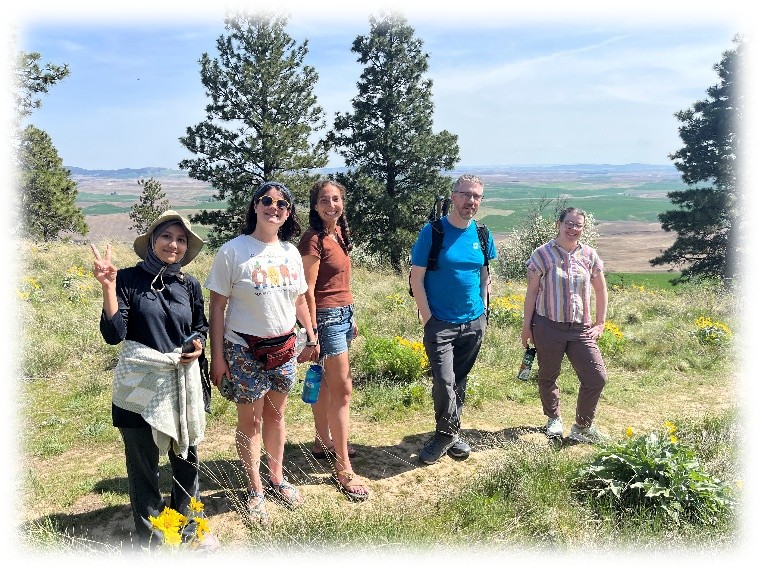
Students on a hike overlooking the Palouse hills
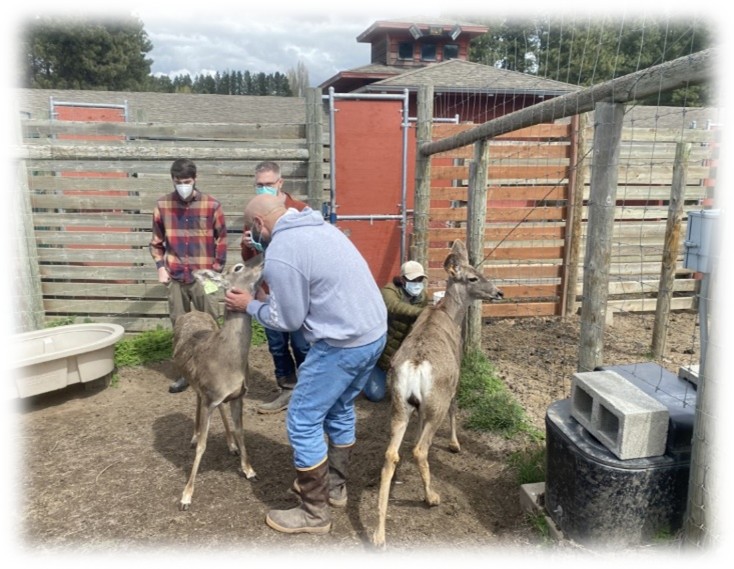
Students working with deer
Doctoral degrees offered
The following is a timeline offered as a guide to the timely completion of the Ph.D. degrees. Note the total duration of any individual’s doctoral program will vary depending on prior degrees earned, the student’s research topics, and specific methodological approaches.
The guide below is typical of a PhD student who entered the program having already earned a M.S. in a related field. Please note some students’ time to degree may vary by 1-2 years based on the scope of the student’s project, however, all WSU graduate students must finish within four years of passing their prelims, per graduate school policy.
Generalized Timeline for PhD Programs
1st Year – Fall
- Assemble dissertation committee
1st year – Spring
- Committee meeting
- Continue coursework
- Begin research
- File program of study
1st Summer
- Continue research
2nd year – Fall
- Continue coursework
- Continue research
- Committee meeting
2nd year – Spring
- Finish coursework
- Complete research proposal
- Prepare for and complete preliminary examination
2nd Summer
- Continue research
3rd year – Fall
- Continue research
- Committee meeting
- Begin data analysis
3rd year – Spring
- Continue research
- Continue data analysis
3rd Summer
- Continue research
- Continue data analysis
4th year – Fall
- Complete data analysis
- Begin writing
4th year – Spring
- Complete writing
- Defend dissertation
PhD in Geology
The Geology PhD program’s main goal at WSU is to train students to be independent researchers and/or educators and to bring them to the forefront of a specialized geoscience subdiscipline. PhD graduates are expected to have demonstrated the ability to conduct independent research and should have the level and breadth of knowledge that one could expect of someone who has attained the highest academic degree in their field. PhD Graduates of the PhD program are regularly employed in specialized geoscience careers, including college-level teaching and/or research, resource industries, or state federal resource and management agencies.
Research performance, as demonstrated by preparation of a dissertation on an independently pursued research topic, is the primary requirement for the PhD degree. The dissertation is expected to be a significant advance forward in solving scientific problems specific to the student’s chosen subdiscipline, and often consists of multiple publishable chapters. Each program is designed with a faculty advisor to meet the student’s needs.
The SOE offers specialization in multiple geology subdisciplines, including:
- Structure/tectonics
- Petrology
- Geochemistry
- Geophysics/geodynamics
- Sedimentology/stratigraphy
Campuses offering PhD in Geology
Academic requirements
- 60 hours minimum graded and ungraded credits, consisting of:
- 15 hours minimum of graded WSU course work at 500 level if student has an MS
- All 15 hours must be completed at WSU
- 24 hours minimum of graded coursework if student has only a BS
- Of these 24, 15 minimum must be taken at the 500 level at WSU
- A maximum of 9 credits of 300 or 400 may be taken toward the 24 required credit hours
- SOE 501 Graduate Skills Seminar, not graded
- 20 hours minimum of SOE 800 – 1 credit during each semester enrolled except summer.
- Courses taken for audit or courses graded Pass/Fail may not be used on the program of study.
- 15 hours minimum of graded WSU course work at 500 level if student has an MS
- Preliminary exam
- Written dissertation
- Final oral exam: Dissertation defense
PhD in Environmental & Natural Resource Sciences
Doctoral research in Environmental and Natural Resource Sciences (ENRS) spans a range of biological, physical, and social sciences that focus on understanding and managing the environment, including diverse aquatic and terrestrial ecosystems and natural resources such as plants and animal.
The PhD dissertation should be a significant contribution worthy of publication in refereed international journals. Specializations are offered in the areas such as:
- Environmental policy and management
- Aquatic ecology, forest ecology
- Wildlife ecology, conservation, and biodiversity
- Quantitative and spatial aspects of natural resources
Program Core Competencies and Student Outcomes for PhD in ENRS
The PhD program in ENRS is designed to educate, train and mentor students in six core competency areas within Environmental and Natural Resource sciences. Those include:
- Advanced knowledge of ecosystems, including biotic and abiotic structure and function, the roles of humans and societies, and applications to management
- Advanced knowledge in research methods and data analysis, including aptitude for assessing a wide range of environmental and/or social science data.
- Ability to critically examine and creatively address interdisciplinary problems.
- Advanced knowledge in the ethics of managing and conducting research in the environmental and natural resource sciences, actively incorporating issues of environmental and social justice, equity, and inclusion.
- Ability to effectively communicate knowledge of environmental and natural resource sciences to a wide range of audiences, through multiple modes of delivery, including written and oral formats.
- A specialized subject area to be defined by the student and the student’s Supervisory Committee.
By pursuing competence in these areas, students who successfully complete the PhD in ENRS will be able to:
- Attain expertise in core disciplinary areas and understanding of interdisciplinary approaches.
- Recognize, think critically about, and develop creative solutions to scientific problems.
- Become effective teachers in field, laboratory, and lecture-room settings.
- Master the field, lab, analytical, and theoretical skills necessary to perform the research.
- Effectively communicate the results of their research.
- Write successful research grant proposals or otherwise obtain research funding.
- Prepare future students to successfully compete for jobs.
- Contribute scientific leadership and expertise at the local, state, and national levels.
- Become visible members of the scientific community by taking organizational and service roles.
Campuses offering program
- Pullman program, for PhD in Environmental & Natural Resource Science
- Tri-Cities program, for PhD in Environmental & Natural Resource Science
- Vancouver program, for PhD in Environmental & Natural Resource Science
Academic requirements
- 60 hours minimum graded and ungraded credits, consisting of:
- 15 hours minimum of graded WSU course work at 500 level if student has an M.S.
- All 15 hours must be completed at WSU
- 24 hours minimum of graded coursework if student has only a B.S.
- Of these 24, 15 minimum must be taken at the 500 level at WSU
- A maximum of 9 credits of 300 or 400 may be taken toward the 24 required credit hours
- SOE 501 Graduate Skills Seminar, not graded
- 1 credit of SOE 593 (seminar, not graded)
- VANCOUVER SOE 598 replaces SOE 593
- 20 hours minimum of SOE 800 – 1 credit during each semester enrolled except summer.
- Courses taken for audit or courses graded Pass/Fail may not be used on the program of study.
- 15 hours minimum of graded WSU course work at 500 level if student has an M.S.
- Preliminary exam
- Written Dissertation
- Final oral exam: Dissertation defense
Academic Requirements, Policies, and Procedures
Continuous enrollment
All full and part-time graduate students must maintain continuous enrollment at Washington State University from their first semester until their degree is completed, regardless of campus location.
To maintain continuous enrollment, students on all campuses must register for at least 2 graduate credits per enrolled semester, excluding summer except under circumstances directed by their advisor, such as summer thesis/dissertation defenses.
Doctoral students who have successfully completed their preliminary qualifying exams, all their program requirements except for their completed dissertation & final exam, and who no longer have available funding may enter continuous doctoral status (CDS). CDS allows doctoral students to continue working on their dissertation without enrolling for credit for the number of semesters allotted by the graduate school after the successful completion of the student’s preliminary qualifying exams (usually 4 years from the date of passed exam). To enter CDS, doctoral students simply do not sign up for credits and will be automatically placed in CDS. Students who have not completed their dissertation within this post-prelim time limit will need to request an official extension.
Students unable to maintain continuous enrollment (e.g., medical, family, financial, military service) may also apply for a graduate leave of absence.
See chapter 5 of the Graduate School Policies & Procedures Manual for more information on continuous enrollment policies.
Normal Academic Load
The Graduate School defines a normal academic courseload as being between 10-12 credits. Some circumstances may require more than this. However, students should do their best to maintain a 10-12 credit courseload for a majority of their degree, as it can put students above the credit limit for satisfactory progress and may potentially impact their financial aid.
Minimum GPA
All WSU graduate students must maintain a minimum cumulative 3.0 GPA to be considered in good academic standing at the University.
Failure to do so may result in probationary status or termination from the graduate program. Please see the Graduate School Policies & Procedures Manual for more details on minimum GPA requirements.
Total Credits & Satisfactory Academic Process
Students must satisfy a certain number of credits per degree prior to submitting their program of study for it to be approved by their advisors and the Graduate School. These requirements are listed below. Also, students must take a minimum of 10 WSU credits per semester to be considered full-time.
Students on assistantship (RA, TA, or GA) must maintain full-time status during any semester in which they have an assistantship. These may be any combination of graded and/or research credits.
Students should read the program requirements in this handbook, listed in summary below. To track these requirements, use the Graduate School’s Program of Study form.
- Master’s thesis-track degrees: No less than 30 hours of approved graduate credit including a minimum of 21 hours of graded coursework, 1 credit of SOE 501 Graduate Skills Seminar, and 4 hours of 700 master’s research. Of these 21 hours of coursework, the student may use up to 6 credits of non- graduate level credit (300 or 400 level) with the approval of their department.
- Master’s non-thesis degrees: No less than 30 hours of approved graduate credit including a minimum of 26 hours of graded coursework, 1 credit of SOE 501 Graduate Skills Seminar, and a minimum of 4 hours of 702 master’s Research. Of these 26 hours of coursework, the student may use up to 9 credits of non- graduate level credit (300 or 400 level) with the approval of their department.
- Doctoral Degrees: Of the minimum 15 hours of core graded coursework (students with an M.S.) or minimum 24 hours of core graded coursework (students without an M.S.) required on the Program of Study, 15 credits must be at the 500-level and taken at WSU.
Expectations for Research Credits: SOE 700/800
During the regular academic year (Fall and Spring semesters), academic research and training is required to measure academic progress through SOE 700 (MS level) or SOE 800 (PhD level) credits each term. With the help of their graduate advisor, students must complete a SOE 700/800 syllabus expectation plan within 10 business days of the beginning of the semester. This form can be found on the graduate student resource page on the SOE website and on the Canvas page for SOE 700/800. Completing the form will be a formal assignment for SOE 700/800 and required for achieving a satisfactory grade. Course expectations for SOE 700/800 include the following:
- Meet with the instructor in the first or second week of each semester to make a Semester Plan. The plan will include goals, due date or timeline, product (e.g., dataset, draft, code). The goals will align with the student’s phase of graduate school, field of study, career aspirations, and number of research credits.
- For every research credit, expect to work approximately of 3 hours per week. Intensity of research work may vary across the semester, so the focus will typically be on results rather than specific number hours worked.
- Meet with the instructor according to a schedule agreed upon by instructor and student (e.g., weekly or every other week).
- Make progress on the identified goals approved by student and instructor. Progress towards these goals and toward the completion of your degree will be considered in the evaluation of a satisfactory or unsatisfactory grade.
- Adhere to professional and ethical standards, including those detailed in the Graduate School Policies and Procedure Manual.
- The instructor and student should each keep a copy on file for the duration of the student’s graduate program.
- If the goals change substantially during the semester, the instructor and student may decide to create a new semester plan.
Whereas students are not typically enrolled in research credits during the summer, they are still expected to make progress on their academic research and training. Summer progress should be determined by the student’s graduate program and advisory committee and should align with their overall academic goals and timeline. Although the exact number of hours may fluctuate, students should anticipate spending a substantial amount of time on their academic work outside of their RA duties to ensure satisfactory progress in their graduate program
WSU Graduate School policy states that two unsatisfactory (U) marks on a student’s research credits (SOE 700, SOE 702, or SOE 800) on their transcript is automatic grounds for dismissal by the Graduate School. Students and advisors should therefore meet as soon as possible after foreseeing a potential problem with research during a semester (or, after a student’s first “U” grade) to discuss plans for meeting research requirements within the constraints of Graduate Policy for the following semester. Graduate students and advisors should let the Associate Director of Graduate Studies & the department Graduate Coordinator know as soon as possible that a student has received a “U” grade, and the “U” should be mentioned on the student’s annual review. If advisors wish to continue working with a graduate student after they receive two unsatisfactory grades on their research credits, the department Graduate Coordinator will need to write an exception to policy memo for the Graduate School. Please contact the Graduate Coordinator to facilitate this process.
Establishing & Communicating with Your Committee
In consultation with their advisor the student is responsible for establishing and maintaining an advisory committee. WSU faculty have the right to decline to serve on any specific student’s advisory committee.
All advisory committee members and the graduate program director must sign the Program of Study. Once the Program of Study has been filed with the Graduate School, changes may be made to the advisory committee composition by completing the Committee Change form.
The vice provost for graduate and professional education has final approval for all advisory committees. The vice provost also has the authority to remove a faculty member from a student’s advisory committee after consultation with the program/department chair, the dean of the college, and the provost, when it is in the best interest of the student and the program.
Master’s Advisory Committee Requirements
The master’s advisory committee guides the student through the master’s program, advises the student on required coursework, oversees the student’s scholarly activities or research, reviews progress toward degree, and conducts the final exam. The master’s advisory committee is officially approved using the program of study form.
Master’s advisory committee composition must meet the following minimum requirements:
- All members of the advisory committee must hold a degree of comparable level to the degree sought by the student (i.e., Master of Science).
- The advisory committee must include at least three current WSU faculty members of any track (career, adjoint, adjunct, etc.).
- Two of the members of the advisory committee must be current members of the Faculty of the Graduate School.
- Two of the members of the advisory committee must be SOE Faculty.
- One member of the committee must be tenure-track or tenured. Career track faculty can be chair with director approval and a 5-year renewable faculty of the graduate school appointment, but another member of the committee must be tenured/tenure-track.
- Advisory committees may have more than three members; however, the majority must be members of the Faculty of the Graduate School.
Non-faculty advisory committee member requirements
Individuals who are not WSU faculty may be considered as additional (beyond three) advisory committee members on an ad hoc basis.
- External advisory committee members must hold a degree comparable to that sought by the student and have specific expertise that is particularly important to the student’s proposed program.
- Examples of external advisory committee members would include faculty from another university or individuals from an appropriate government, business, or industry organization.
- Such an individual must be nominated to serve on an advisory committee by the associate director to the vice provost for graduate and professional education, who makes the final decision. A current curriculum vitae and nomination memo must be included with the request, which is submitted through the GRM along with the Program of Study or Change of Committee form.
- Submit the external member form (found on the grad school website) before the end of your second semester. So, the school has time to process the form before your program of study is due at the beginning of your third semester.
PhD Advisory Committee Requirements
The doctoral advisory committee is officially approved using the program of study.
All doctoral advisory committee members are normally expected to hold a PhD. On a case-by-case basis, the vice provost for graduate and professional education may approve research active faculty, with other doctoral or equivalent degrees, to serve on a PhD advisory committee.
- Each doctoral advisory committee must include at least three members of the current Faculty of the Graduate School.
- At least two of the members must be graduate program faculty in the WSU School of the Environment (SOE).
- Two committee members must be tenure-track or tenured. Career track faculty can chair committees with nomination from the director of the school and a five-year appointment, which can be renewed. If the chair is a Career-track faculty, 2 other members of the committee must be tenure track.
- Advisory committees may have more than three members; however, the majority must be members of the Faculty of the Graduate School.
- Individuals who are not WSU faculty may be considered as additional (beyond three) advisory committee members on an ad hoc basis.
- External advisory committee members must hold a degree comparable to that sought by the student and have special knowledge that is particularly important to the student’s proposed program.
- Examples of external advisory committee members would include faculty from another university or individuals from an appropriate government, business, or industry organization.
- Such an individual must be nominated to serve on an advisory committee by the chair or director (in the academic program, department, or school) to the vice provost for graduate and professional education, who makes the final decision. A current curriculum vitae and nomination form must be included with the request, which is submitted through the GRM by the graduate academic coordinator (along with the Program of Study or Change of Committee form.
Conflicts of Interest
Potential conflicts of interest should be acknowledged when forming a graduate student’s advisory committee. Examples of potential perceived or real conflicts of interest include:
- a new faculty member who was a former graduate school peer
- a faculty member who is the employer or supervisor of a staff member pursuing a degree
- faculty members whose impartiality may be impacted because of close professional or personal relationships that are separate from their WSU faculty roles
Faculty who were SOE grad students will need to wait at least two years from their graduation, per Graduate School recommendation, to serve on an SOE student’s committee to negate potential conflicts of interest.
The vice provost for graduate and professional education has the final approval for all advisory committees. The vice provost also has the authority to remove a faculty member from a student’s advisory committee after consultation with the program/department chair, the dean of the college, and the provost, when it is in the best interest of the student and the program.
Graduate Committee Membership Requirement Table
| Committee Member | Must be WSU Graduate School faculty? | Must be SOE Approved Member of the Faculty of the Graduate School? | Must be Tenure-track? | Degree must be equal or greater than that sought by student |
|---|---|---|---|---|
| 1st member (not necessarily advisor) | Yes | Yes | Yes | Yes |
| 2nd member | Yes | Yes | Yes (PhD only) | Yes |
| 3rd member | Yes | No | No | Yes |
| Optional additional members | No | At least 50% of all members must be faculty of the Graduate School | No | Yes (and is approved by the SoE Associate Director of Graduate Studies) |
Meetings With Advisor & Committee
Regular meetings with advisors are important for communication and success as a graduate student. In a student’s first meeting with their advisor, they should establish a plan for regular meetings. Many students & advisors meet weekly to once every two weeks when possible.
Full committee meetings may be less frequent due to committee availability and scheduling constraints but should be at least once per year per graduate policy. See page 54 of the Graduate School Policies and Procedures manual for more information.
Annual Review of Graduate Students
The annual review is a yearly performance process completed by a graduate student and their advisor each year. All parts of the annual review are mandatory, per WSU graduate school policy, for all graduate students, including those on leave.
All currently enrolled graduate students, including those graduating in the spring semester, and their advisors must complete the following:
- A performance review of academic progress towards the degree, to be completed independently by the student’s major advisor.
- A performance review of the student’s work as a research or graduate assistant (if applicable). This review is completed by the student’s assistantship supervisor.
- A Microsoft Form documenting student activity through the year, used mainly for data collection for graduate school reports. This should be completed independently by graduate students.
- An updated (within the past year) CV or Resume.
The review form is distributed to students by the graduate coordinator in January of each year. These reviews cover the previous calendar year (January through December) rather than the current academic year.
The results of each section are to be discussed in a meeting between the students and their advisor. Addendums may be added separately after the review in addition to the independently completed sections. The review process is outlined in Chapter 6, Part B, of the Graduate School Policies and Procedures Handbook (Academic Evaluation of Students).
All completed advisor/supervisor annual reviews should be signed by students & advisors. The graduate coordinator will pull a copy from Canvas to keep on record.
Separate assessment of academic performance & employment duties
The student’s academic research performance will be assessed independently from their performance of assigned RA duties. Academic research performance is measured by SOE 700 or 800 research credits during the regular academic year and overall academic progress during the summer.
Each year, the student’s academic progress will be evaluated, at minimum, by their advisory committee based on factors such as academic milestones, quality of work, and overall progress toward completion of the thesis or dissertation. At least annually, the Academic Student Employee (ASE)’s performance is to be assessed separately by their assistantship supervisor, as described in the WSU/UAW Contract Article 33.4.2. This assessment focuses on fulfilling assigned duties, quality of work, professionalism, and other relevant factors outlined in the appointment letter and job description.
Communication & Oversight
Regular communication between the student, RA supervisor, major professor/advisor (if different than RA supervisor), and graduate program leadership is crucial to ensure an appropriate balance between employment duties and academic progress. Students are to raise any questions they have about distinguishing between their RA duties and their academic research and training (including but not limited to their thesis or dissertation) to their supervisor or program director. Supervisors and program directors are to periodically review the RA’s responsibilities and adjust as needed to optimize the student’s overall academic and professional development.
Grievances
Graduate students are entitled to file formal grievances of fellow students, staff, and faculty members following the guidelines set forth in the WSU Graduate School Policies & Procedures manual.
Students also have a right to grievance representation under the UAW/WSU mutual agreement. For more information, please see Article 37 of the UAW/WSU 2024-2026 agreement.
Navigating Your Degree
Program of study
Specific courses to be included in a student’s Program of Study are determined as a joint effort between the student, their committee chair, and other members of the advisory committee to meet the needs of the student.
All incoming master’s students and PhD students who lack prior Graduate School experience must take “SOE 501: Graduate Skills Seminar” during their first fall semester and include this in their program of study. This course introduces students to graduate study at WSU, the scientific method, and research proposals and presentations. The student’s advisory committee and the department chair must approve the Program of Study before it is submitted to the department graduate coordinator and signed off on by the director.
All other graded graduate-level coursework (with a grade of B or higher) taken as a graduate student, but not taken toward a completed graduate degree, may be used toward a master’s degree at WSU with the approval of the student’s advisory committee and program director. In all transfer cases, the number of such credit hours is limited to half of the total graded course credits required by the program listed on the Program of Study. PhD students must take 15 graduate credits at WSU, but may transfer additional graduate credits for their program of study (for a total > 15 credits) with the approval of the student’s advisory committee and program director
Courses taken to remove undergraduate deficiencies cannot be taken for a Pass/Fail grade. Any course included in the advanced degree program in which a grade of “C- “or below is earned must be repeated, but not on a Pass/Fail basis. Courses taken for audit or courses graded Pass/Fail may not be used on the program of study.
Well before finalizing research plans and submitting their program of study, students should consult with their advisors to determine whether they need to seek IRB or IACUC approval. IRB approval is needed for research involving humans, and IACUC approval is required for research including animals. See the WSU IRB page and the WSU IACUC page for more information. IRB/IACUC paperwork is not required to submit the program of study, but it is required for research and for the student’s final exam (if applicable).
Research Proposal Requirements for SOE Graduate Students
The research proposal requirement aims to help students develop the best possible plan for their thesis or dissertation, making use of committee input. Specific goals include:
- Ensure that the student’s study design and plan for analysis is adequate to address study objectives
- Provide the opportunity for the student’s advisory committee to give suggestions and raise any concerns prior to preliminary exams, substantial data collection, and defense
- Ensure students have adequate background knowledge about the research subject and methods before implementing their study
- Provide students with additional experience writing a proposal for future grants and projects
MS students
- Research plan is recommended at the discretion of the advisory committee
- Research plan should ideally be completed before substantial work has been done on the thesis research
PhD students
- Proposal is required
- Proposal must be approved by advisory committee ideally before signing off on preliminary exam paperwork, or by the end of the semester of the preliminary exam if necessary.
- Proposal should be completed before substantial work has been done on the dissertation research, although approach may vary as directed by committee.
- Proposal should be recorded on graduate student annual review for SOE records.
Content of Proposal
The length and specific content of the proposal can be decided by the student’s advisory committee, and will vary depending on project logistics, study area, and other factors. The length of the MS study plan is expected to be shorter than the proposal required for PhD students.
The recommended content of the proposal includes:
- Literature review on the dissertation/thesis topic and methods to demonstrate in-depth knowledge
- Objectives (and hypotheses where applicable) for research
- Outline of methods for each proposed chapter, with a clear explanation of how methods will address the stated objectives/hypothesis
- Expected schedule for completion of thesis/dissertation
Use of Artificial Intelligence (AI)
As one of the purposes of the written portion of the PhD preliminary examinations is to assess the student’s ability to craft comprehensive, reasoned, and effective written answers to questions they are given, the use of generative AI to assist in writing is prohibited. This includes use of AI to write content, rephrase sentences, organize or structure written content, and generate outlines or other content used to answer the questions. AI can still be used to assist in searching for references (if the exam is open book), and for basic spelling/grammar checking that is built into many word processing software packages. Similarly, the thesis or dissertation represents the culmination of a graduate student’s degree program, and should reflect the student’s own ability to conduct a study and communicate the results in written form. Therefore, the use of generative AI to assist in writing of theses or dissertations is also prohibited.
Preliminary Examination of PhD Students
Every WSU student must pass a preliminary examination to become a PhD candidate. This examination is taken after most of the required coursework has been completed, as determined by the dissertation committee and graduate policy, and upon submission of a dissertation research proposal, usually after the second year in the program.
It will consist of a written exam followed by an oral defense, the format of which will be determined by the individual committee. Both will focus on the student’s major area of competency, courses taken, and the subject matter of the proposed research.
It is best practice for graduate committees, including external committee members, to allow students ample time and give their students preparatory materials to prepare for their preliminary exam. All committee members, including external students, should follow the faculty mentorship guidelines and graduate school policies and procedures regarding best practices for exams.
In the event of a failed first attempt of an exam, a second and final attempt may be scheduled after a period of at least three months, but no longer than two academic semesters (excluding summer). When scheduling a second exam, the scheduling form must be submitted to the SOE graduate academic coordinator at least 16 business days before the exam. A member of the Graduate Mentor Academy will be appointed by the Graduate School and must be present at re-examination. The entire committee must be present and vote.
Thesis, Dissertation, and Final Examination
The final examination will consist of a defense of the thesis or dissertation. All students must present a seminar to the faculty and public on their research. Graduate students will be required to upload a draft of their thesis/dissertation to ProQuest and provide a digital copy of their thesis to their department graduate academic coordinator.
Committee members, including external committee members, are required to read the student’s dissertation prior to scheduling a defense date to ascertain whether the dissertation is ready to defend. Depending on the dissertation, advisor’s preference and the student’s writing ability, the student should generally allow three to four weeks before their exam to address the rough draft comments. PhD Students should allow a longer period for review, ideally three weeks per chapter or at their committee’s discretion.
Because a student only has ten working days after defending their dissertation to turn in the final version to the Graduate School, most substantial changes should be addressed prior to defending their written thesis or dissertation during the final exam. Students and committees should work together to ensure that there is ample time prior to a student’s defense to make substantial changes.
Students submit their thesis following the Graduate School directions listed on Graduate School dissertations and theses web page at least 13 days prior to the proposed exam date, preferably earlier. This draft should be as close to complete as is possible, though revisions are expected after the student’s defense.
Dissertation submission, revision, and subsequent committee chair signoff is done digitally. If students would like their advisor & committee members to sign a physical signature page printed on cotton paper, they may ask the graduate coordinator at their campus to print their signature page off on 100% cotton paper as a keepsake. However, even if pages are physically printed and signed, all digital exam components must be completed. Please see WSU Electronic Theses and Dissertations (ETD) Formatting Checklist for a list of post-defense items required by the graduate school.
All members of the advisory committee must present, participate, and ballot in the final oral presentation and examination (defense). Committee members, especially committee chairs, have final tasks to complete after their student defends. The public and additional members of the WSU community (students, staff, faculty) can attend any oral presentation component of the preliminary examination and ask questions. Only members of the student’s advisory committee and SOE Graduate Faculty can attend and participate in the oral preliminary exam (i.e., ask questions and ballot).
If any SOE graduate faculty besides the student’s advisory committee is planning to ballot on either a preliminary or final exam, they must notify in writing the SOE Graduate Coordinator (Zoeii Freeman), the Associate Director for Graduate Studies (Dan Thornton), and the Chair of the student’s advisory committee within 3 days of the announcement of the exam, and they must have read the student’s thesis.
After a successful final exam, the student has ten business days to do the following:
- Email the Hold Harmless form to gradschool@wsu.edu
- Complete the thesis approval form.
- Complete the survey of earned doctorates (Ph.D. only).
Degree Extensions
Students have a set period in which to finish their degree, as outlined by WSU graduate policy.
All master’s students must request an extension if they have not completed their degree within six years.
Doctoral students must meet two deadlines:
- They must graduate within four years of successful completion of their preliminary qualifying exams
- They must complete their degree within 10 years of beginning the program
If a student cannot complete their degree within the timeframes above, they will need to request an official extension from the graduate school.
Please read the graduate school policies and procedures manual thoroughly before requesting an extension.
Note on Extensions
We strongly encourage students to adhere to suggested SOE degree completion guidelines whenever possible. However, in cases where it is impossible to adhere to the degree completion guidelines, it is recommended students meet with their advisors as soon as they recognize they may need more time to complete their degree. Students and advisors should discuss funding, workload expectations (following WSU policy), and other potential issues surrounding extended completion so both parties are aware of their responsibilities. If students or advisors have questions about funding or policy, they should contact the departmental graduate coordinator.
Of specific importance: Students must be enrolled for at least two research credits during the semester in which they complete their degree. If no funding is available to students to cover these credits, advisors should let their students know so the students can prepare for the cost of credits.
How to request an extension
First extension
- The student must petition their committee chair in writing (email preferred).
- The chair(s) of the committee must meet with the advisory committee and all members must agree on the student’s extension.
- When all are in favor, the advisor should forward a copy of the student’s email request and detailed memo on SOE letterhead explaining why the request is being made, including details about any delays. Please reach out to the graduate coordinator if you need the latest version of the letterhead.
- The graduate coordinator will upload these materials to the GRM for review by the Vice Provost of Graduate and Professional Education.
- Upon approval by the Vice Provost, the student will have one year to complete their degree.
Second extension
- The student must petition their committee chair in writing (email preferred). The student must explain in this request:
- Why they could not complete their degree during the first extension.
- A detailed plan for completing their degree during the upcoming year extension (if granted) including generalized dates for deliverables
- The student must schedule and discuss this plan with their committee.
- The entire committee must vote positively upon the second extension.
- Upon a positive vote from the student’s committee, the committee advisor will email the SOE graduate coordinator to notify them of the results of the committee meeting.
- The SOE graduate coordinator will attend the next SOE faculty meeting whereby the Associate Director of Graduate Studies will conduct a vote of the entire SOE graduate faculty. The Graduate coordinator will collect the results of the vote.
- After the vote, the chair of the student’s graduate committee will submit a memorandum to the SOE graduate coordinator and director of the SOE explaining the rationale for this extension, providing the details of the timeline, verifying the date of the thesis/dissertation meeting, and indicating that the advisory committee concurs with the decision to request a second extension.
Third extension
- The student must submit a request for a third extension to the student’s advisory committee chair explaining:
- why the thesis/dissertation was unable to be completed after a second extension.
- The student must also develop a detailed timeline for completing the thesis/dissertation.
- The advisory committee chair must evaluate and approve the rationale and timeline for the requested third extension. The student must schedule and complete an advisory committee meeting during which the timeline for completion is discussed.
- A graduate program faculty meeting must be held during which the student’s request for a third extension is discussed. Once the thesis/dissertation advisor presents the circumstances for this request, the chair or director of the degree-granting unit must ballot the graduate program faculty for their support of the request.
- The results of this balloting must be reported to the Graduate School as part of the request for a third extension.
- If the faculty supports the request, the chair or director of the degree-granting unit must write a memo to the vice provost for graduate and professional education explaining the rationale for the request, providing a detailed timeline for completion of the thesis/dissertation within one year, and including any extenuating circumstances that need to be considered.
- The memo, supported by the materials listed above, should be forwarded to the Graduate School by the program’s graduate coordinator using the GRM.
- If approved, the vice provost for graduate and professional education will write a letter to the student explaining that this is a third and final extension.
- The student must acknowledge receipt of this letter in writing to the vice provost for graduate and professional education and the chair, explaining that they understand this is their final opportunity to complete the thesis/dissertation degree.
- Note: Students must be enrolled for at least two research credits during both the fall and spring semesters of a third extension or until degree completion.
Important Forms for Navigating Degrees
Please send all completed forms to the SOE Graduate Coordinator for review before submitting at least 36 business hours before the graduate school deadline. (I.e. Grad school says 10 days, please return to the grad coordinator in 13 business days so they have time to get it in by the 10th day.)
Students should sign and collect all committee signatures before submitting to the graduate coordinator. The graduate coordinator will collect the SOE director’s signature after proofreading the form.
Find all graduate forms at the Graduate School forms web page.
Common Forms to be Completed:
- All But Dissertation (ABD) waiver: For doctoral students only who have completed their preliminary qualifying exams and are done with all schoolwork.
- Due: immediately after successful completion of preliminary qualifying exams
- Committee Change Form: For indicating a committee change after a program of study has been approved.
- Due: Any time your committee changes
- Program of Study Request Form: Graduate school approval for your degree plan & committee
- Due:
- Pullman, Tri Cities, and Puyallup:
- Third semester of study, by the following dates:
- 8/25 for MS students
- 9/25 for PhD students
- Third semester of study, by the following dates:
- Vancouver
- 2nd semester of study by the following dates:
- 9/1 for MS students
- 10/1 for PhD students
- 2nd semester of study by the following dates:
- Pullman, Tri Cities, and Puyallup:
- Due:
- External Committee Member Request: Any time a student has an external to WSU committee member as their fourth committee member
- Due: At the same time you pass in your program of study
- Residency Questionnaire: For all students who will be on an assistantship at any point in their graduate career at WSU. Assistants are required to be WA residents after their first year in the program, including those who are on alternate funding their first year (excludes international students).
- Due: Form is due 1 year from start at WSU. The residency process starts immediately upon arriving at WSU. See the residency page, as well as the next page in the SOE handbook, for more details.
Helpful Information for SOE Graduate Students
Graduate program administration
The graduate programs operated by the School of the Environment are administered according to Program Bylaws approved by the Graduate School. Copies of bylaws for each degree program can be found at the departmental offices or from the Associate Director for Graduate Programs.
Additionally, graduate students must abide by and meet the regulations and policies set forth in the current Graduate School Policies & Procedures Manual.
The WSU Graduate School: This web site has important information students need to know concerning their graduate studies at Washington State University, including but not limited to: financing education, residency requirements, health services, housing, child care and international student concerns.
One of the most important components of the Graduate School website is the Forms page. The forms found here will be used for official steps in a student’s graduate program. Typically, these forms will be signed by the student, the faculty advisor (committee chair), members of the student’s committee, and the Associate Director for Graduate Programs.
Office of the Registrar: The office of the registrar includes general announcements and lists upcoming academic events and links to the time schedule, academic calendar, academic regulations, the University Catalog, residency information and more.
Time Schedule (schedules of classes): Includes detailed course listings, information on registration procedures, payment of fees, textbooks, and the University academic calendar.
Residency
In-state tuition for Washington residents is considerably less expensive than non-resident tuition for out-of-state students. Therefore, all domestic graduate students should establish Washington State Residency immediately upon arrival to Washington. Note that graduate assistantship appointments require that students reside in Washington. Non-resident tuition waivers for assistantships are available for a graduate student’s first year of graduate school only, regardless of whether they were appointed to an assistantship that year. After the first year, if a student has not established legal residency in Washington, the student will be responsible for paying the non-resident portion of their tuition.
Exceptions to this policy include:
- International students, who are exempt from this requirement
- Members of certain U.S. tribes, per the American Indian Residency Bill
Living outside the state of Washington (e.g. in Moscow, or any nearby Idaho or Oregon town), negates residency eligibility.
Students will need to establish ties in Washington State during their first year in the program to be eligible for residency the next year. Within two weeks of arriving on campus, students should be sure to complete the applicable items in the list. After they have lived in Washington for one year, they should submit a residency questionnaire to the Graduate School along with all of the following items:
- Any home purchase agreements, lease agreements, rents receipts or cancelled checks, or letters from landlords that verify physical residence in Washington for 12 consecutive months prior to the first day of the semester in which the student submits their residency application.
- A copy of the student’s Washington State driver’s license. Students must obtain a Washington State driver’s license at least one year prior to the semester in which they apply for residency. If they do not drive, they should provide a copy of their Washington State identification card.
- A copy of the student’s Washington State vehicle registration issued one year prior to the semester in which they apply for residency. Failure to provide this will likely result in a denial of Washington residency for tuition purposes.
- A copy of Washington voter registration issued one year prior to the semester in which the student applies.
- Proof of having established a bank account in Washington. Any other document the student must show that they have established ties in Washington for the one year prior to the semester in which they apply for residency (clubs, organization, etc.)
Financing Education
Financial support for graduate students is most commonly available in the form of either a graduate teaching assistantship or research assistantship. Graduate assistantships normally include tuition waivers and health benefits, but do not include university fees each semester, which are subject to change. Find information about fees at the Cost and Finances page.
Teaching Assistantships
If students have been awarded a Teaching Assistantship (TA), they will have already received a letter stating the terms of that appointment. Teaching assistantships are state-supported, half-time, nine- month positions available to students with strong academic records. Teaching Assistantships require a 20 hours per week commitment of paid work and may involve teaching laboratory sections, grading homework and exams, answering questions during office hours, or any combination of those duties.
Research Assistantships
If students have been awarded a Research Assistantship (RA) position, they will have already received a letter stating the terms of that appointment and listing the faculty member who has agreed to provide funding. Research assistantships require a 20 hours per week commitment of paid work conducted for an externally funded research project, usually acquired by the student’s graduate advisor.
Hourly Wage Positions
The selection process for awarding graduate teaching and research assistantships is highly competitive. For students who are not awarded research or teaching assistantships, hourly wage positions may be occasionally available to provide partial financial support through the department. Please speak with your faculty advisor about potential hourly wage positions.
Scholarships & Fellowships
The Graduate School and other academic departments offer a variety of funding opportunities for new and current students. Information can be found on the Graduate School website under “Funding Opportunities”.
For highly qualified applicants, graduate fellowships are available from the National Science Foundation (NSF), the Department of Defense, the Environmental Protection Agency, and other state and federal agencies, nonprofits, and private foundations. Such fellowships are highly competitive but provide graduate students with a greater degree of freedom to pursue creative research while in graduate school. Interested students should work with their faculty advisors on these applications.
SoE Grants and Scholarship
Each academic year, a few internal grants and scholarships are available to SoE graduate students. These provide additional support for graduate students for reasons such as paying semester fees not covered by a student’s tuition waiver, buying books, and other relevant academic situations. Information about the application process will be made available late in the Fall semester. The due date for application is usually January 31st annually. Students should monitor their school emails for correspondence about internal scholarships starting in December. If they have not received any information about scholarship applications by mid-January, students should email soe.academics@wsu.edu to be put in touch with the scholarship committee for more information.
For International Students
International graduate students often have special concerns that may affect their course of study, finances, and length of stay in the United States. The Office of International Programs is a valuable resource for those concerns. The Office of International Programs (IP) is in Bryan Hall Room 108; the phone number is 1-509-335-4505. Visit the International Programs website.
If the student is not a U.S. citizen, but holds permanent resident immigration status, temporary resident status, or refugee status, they should submit a copy of both sides of their Resident Allen Card, Form I-94, Temporary Resident card or other verification of their status with immigration and Naturalization Service (INS).
For all international student issues such as tuition rates, residency requirements, employment, social security numbers and taxes, and learning English please contact the Office of International Programs directly.
Cooperative Courses at the University of Idaho (UI)
WSU and the University of Idaho operate a cooperative agreement by which WSU Pullman students can register at UI and take approved courses offered by UI at no extra charge. These are typically classroom courses taught on the nearby UI campus in Moscow, ID, or online. A list of UI courses available to WSU Pullman students is available at the University of Idaho’s U of I and WSU cooperative education web page.
Students should notify their faculty advisor and the graduate coordinator before signing up so that they can ensure the student signs up without risking any graduate policy or enrollment issues.
As of Fall 2024, the registrar automatically adds U of I Co-op courses to student transcripts.
Outside Service & Club Commitment
Students are strongly encouraged to participate in the SOE & WSU community providing these activities do not influence their ability to complete assistantship duties, maintain their GPA, and complete their thesis/dissertation on time. Social service is good for resume & experience building, and it is one of many rewarding activities that help prevent student burnout.
Below are some of the School of the Environment’s clubs & organizations as well as some WSU organizations with which SOE students are normally affiliated:
- SOE Graduate Student Association (GSA)
- Graduate Student Professional Association (GPSA)
- Environmental Science Club
- WSU Forestry Club
- Geology Club
- SAFE (Student Association for Fire Ecology)
- Water Resources Club
- Backcountry Hunters & Anglers
All-Campus Resources
Here is a comprehensive list of resources.
Resources include: WSU CASE/UAW information, Academic, Disability, Financial, Food & Clothing, Health, Housing, Identity & Campus Involvement, Safety & Transportation, Tech, Policies, and Training resources and things to do in the areas around your campus.
Many thanks to former Pullman M.S. in ENRS student Ksenia Pereverzeva for putting this together.
SOE Key Faculty and Staff Directory
- Allyson Beall King, Director
- Webster 1229 (Pullman)
- abeall@wsu.edu
- (509) 335-3009
- Dan Thornton, Associate Director of Graduate Studies
- Webster 1152 (Pullman)
- daniel.thornton@wsu.edu
- (509) 335-3713
- Jonah Piovia-Scott, Program Leader (Vancouver)
- jonah.piovia-scott@wsu.edu
- (360) 546-9210
- Kara Whitman, Associate Director of Undergraduate Programs
- Fulmer 206BC (Pullman)
- kmwhitman@wsu.edu
- (509) 335-7846
- Jessica Billings, SOE Business Services Manager
- Webster 1226 (Pullman)
- jessica.billings@wsu.edu
- (509) 335-0430
- Zoeii Freeman, SOE Graduate Coordinator (Pullman, Puyallup, Tri Cities)
- Webster 1226 (Pullman)
- soe.academics@wsu.edu
- (509) 335-6160
- Diego Murillo, CAS Graduate Coordinator (Vancouver)
- Science & Engineering Building (Vancouver)
- van.cas.gradcoordinators@wsu.edu
- Christopher Riddle, Fiscal Technician
- Webster 1226 (Pullman)
- christopher.riddle@wsu.edu
- (509) 335-6227
- Amanda Wagar, Post-Awards Grants Coordinator
- Webster 1226 (Pullman)
- soe.grants@wsu.edu
- (509) 335-3009
Please see SOE Faculty and SOE Staff for a complete list of current SOE faculty and other personnel.
SOE Graduate Program Hierarchy Chart
The heading structure below illustrates the hierarchy of the School of the Environment Graduate Program. The WSU Graduate School is the ultimate authority over the entire program but both the College of Arts and Sciences and the College of Agricultural, Human & Natural Resources share management of the program equally.
WSU Graduate School (tier 1)
“College of Arts & Sciences” and “College of Agricultural, Human & Natural Resources” (tier 2)
Director of the School of the Environment (tier 3)
SOE Associate Director of Graduate Studies (tier 4)
SOE Graduate Faculty (tier 5)
Graduate Student (tier 6)
Glossary
Glossary of Terms
- ABD – Stands for “All but Dissertation”, indicating a doctoral student has completed all their studies and is in the process of collecting and analyzing data and constructing their dissertation.
- ABD Waiver – A type of tuition waiver that may be requested after a doctoral student has completed their preliminary qualifying exams.
- Academic Load – The number of credits a student takes during a semester and/or during the academic year.
- Academic Year – The period between the start of fall semester and the end of the spring semester.
- At WSU, these dates do not change. They are from 8/16 to 5/15.
- Appointment – The period during which a graduate student has an assistantship.
- Assistantship Advisor – The faculty member or instructor a student reports to for their assistantship. This may be their committee chair, or it may be a different person.
- Assistantship – A paid graduate student employment position.
- Associate Director of Graduate Studies – The Associate Director of Graduate Studies oversees departmental graduate studies policy updates and changes under the guidance of the department’s director and WSU Graduate School policy.
- The Associate Director of Graduate Studies for the SOE for the 2025-2026 Academic Year is Dan Thornton.
- The Director of the School of the Environment for the 2025-2026 Academic Year is Allyson Beall King.
- CAHNRS – Stands for the College of Agricultural, Human, and Natural Resources. The School of the Environment is jointly administered by CAHNRS and CAS.
- CAS – Stands for the College of Arts and Sciences. The School of the Environment is jointly administered by CAHNRS and CAS.
- Committee Chair – The main faculty member who guides graduate students through their graduate degree via coursework direction, professional training, and research mentorship.
- Committee – A group of three or more faculty members who oversee the guidance of a graduate student’s thesis or dissertation.
- CV – Stands for “Curriculum Vitae”. A CV is a brief account of a person’s education, qualifications, and previous experience. CVs do not have a length limit and focus on positions and experience relevant to academic and/or research positions.
- Defense – The oral evaluation component of a student’s written thesis or dissertation.
- Director – A faculty leadership position overseeing educational, financial, performance, and other departmental growth and evolution.
- Discipline – A specific branch of knowledge.
- Dissertation – The cumulative written document showcasing the research and results of a doctoral research project.
- Doctorate Degree – The highest earnable postgraduate degree for a student in the sciences.
- Embargo – A restriction placed on a thesis or dissertation that allows only the title, abstract, and citation information to be made public for a short period of time.
- Faculty Advisor – The faculty member overseeing the direction of a graduate student’s master’s or doctoral project. This may be a chair or a co-chair.
- FTE – Stands for “Full Time Equivalency” in reference to an appointment. E.g., 50% FTE = half time.
- Full Time Enrollment – The number of credits needed to be considered a full-time student.
- For graduate students at WSU, Full time enrollment is 10 credits.
- Graded Credits – Credits for which a student receives a grade on the A-F scale.
- Graduate Academic Coordinator – An academic staff member whose responsibilities include guiding current graduate students on departmental and university graduate policy and promoting graduate programs.
- Half-Time Enrollment – Half time enrollment indicates an enrollment threshold under the full time minimum.
- At WSU, half-time enrollment for graduate students is between 5-9 credits.
- IACUC – Stands for “International Animal Care and Use Committee”. All graduate students involved in animal research must have their projects approved by IACUC before carrying out research.
- Interdisciplinary – Of or relating to more than one branch of knowledge.
- IRB – Stands for “International Research Board”. Any student conducting research involving humans will need their research approved by the international research board.
- Master of Science – A postgraduate degree in science that introduces students to research and advanced literature and theory in the field.
- Master’s Degree – A postgraduate degree awarded to a student by a university
- Minimum Enrollment – Minimum enrollment indicates the minimum number of credits needed to continue membership of a degree program.
- At WSU, minimum enrollment for graduate students is 2 credits.
- Pass/Fail Credits – Credits graded on a pass or fail basis rather than on an A-F scale
- Postdoctoral Degree – A period of research and/or training done by people who have recently finished a doctoral degree.
- Preliminary Qualifying Exam – An examination given to doctoral students, usually in their third or fourth semester, which qualifies students to continue their studies at a higher level.
- Program of Study – A document completed by all WSU graduate students outlining all courses they intend to take during their time in the program and identifying their committee members.
- ProQuest – A document management platform utilized by universities to showcase graduate student theses and dissertations.
- Research Assistantship – A paid student position for graduate students in which the student performs research-based activities for a WSU-related study, including their own.
- Research Credits – Credits graded on a pass-fail basis used to measure the output and time requirements needed for a graduate student to complete their research.
- Research Proposal – A formal report, completed in the first three semesters of a student’s study in a graduate program, outlining a student’s research plan, methodology, and the literature that has been reviewed before starting their research.
- SOE – Stands for “School of the Environment”. An interdisciplinary school managed by the College of Arts and Sciences and College of Agricultural, Human, and Natural Resources.
- Stipend – Pay received by an Academic Student Employee in return for the work done in their assistantship appointment.
- Teaching Assistantship – A paid student position for graduate students in which the student performs teaching-based activities for WSU courses, typically in their own departments.
- Thesis – The cumulative document showcasing the research and results of a master’s research project.