
Our mission with the Forest Ecology and Management major is to educate the future generation of forest stewards equipped with essential technical knowledge and skills expected of professional foresters and a broad interdisciplinary background with particular strengths in plant ecology, GIS, and remote sensing. Our graduates will excel in critical thinking, open mindedness, and the ability to adapt their forestry knowledge and skills to a wide range of social, ecological, and economic contexts. In addition, our graduates will be able to collaborate across diverse worldviews and knowledge systems to sustainably and justly steward forests to support the multiple values of current and future generations of human and non-human communities.
A minor in geospatial analysis is built into the curriculum.
The Forest Ecology and Management program is provisionally accredited under the Society of American Foresters accreditation standards for forestry programs.

Your Experience in Forest Ecology and Management
- The major prepares you to work as a professional forest ecologist, performing tasks ranging from increasing timber production to restoring wildlife habitat.
- The major combines a strong background in the plant sciences with a strong emphasis on spatial analysis including landscape ecology and GIS.
- Graduates are expected to be field ready with a strong background in plant identification, forest measurements, and forest stand management.
- Students benefit from an integrated common core of coursework rooted in the environment, taken in concert with students majoring in related disciplines.
- Hands-on experience in on-campus and off-campus laboratory exercises and internship opportunities.

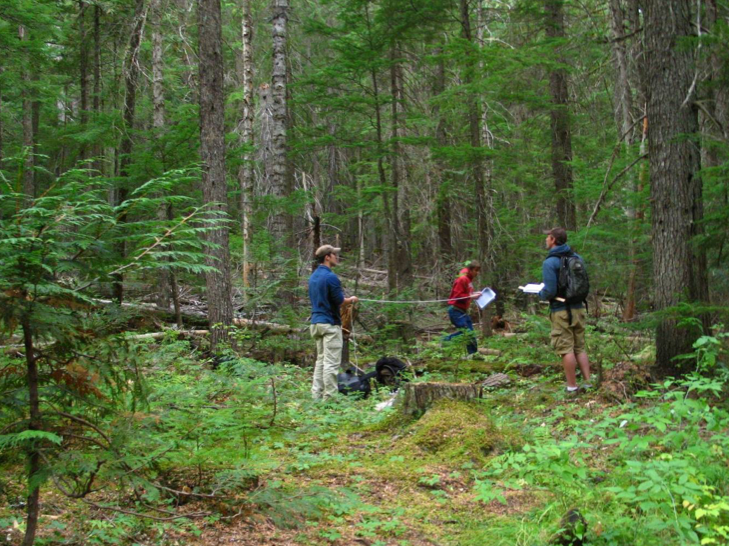

Your Hands-on Experiences
The program is comprised of both classroom-based science instruction and out-of-classroom experiences that allow students to apply theory to practice through field trips, internship opportunities, and study abroad options. Students are also supported in investigative problem solving with opportunities for undergraduate research and a capstone course taken in the final year.
Your Career Options in Forest Ecology and Management
WSU Forest Ecology and Management graduates are ready for careers in private industry, non-government organizations, and local, state, and federal government as:
- Multiple uses of forests
- Forest restoration
- Forest sustainability and carbon project auditing
- Community forest stewardship
- Forest conflict resolution
- Production forestry
- Tribal forest stewardship
- Wildfire and fuels management
- Forest wildlife management
- GIS and data management related to public lands
Program Learning Outcomes
- Students will demonstrate understanding of the complex interactions of humans and forest ecosystems in a global context.
- Students will be able to exhibit forest mensuration skills, techniques for ecological measurements, and other quantitative and analytical skills for data collection, analysis, and interpretation of forest ecology and management.
- Students will be able to independently locate and apply relevant forest ecology and management literature to assigned problems or research and management issues.
- Students will be able to interpret a wide range of scientific and popular literature related to forest ecology and management and apply this information to problem solving analysis in the conservation and management of forest ecosystems.
- Students will be able to prepare analyses and present both written and verbal technical reports of forest conservation, ecology, and management as appropriate for either scientific or popular audiences.
- Students will be able to interpret forest conservation, forest ecology, and resource management conflicts and solutions from multiple perspectives ranging from private landowners to industry and public lands.
- Students will be able to effectively analyze and integrate the social and natural sciences to understand diverse challenges to forest management and conservation ranging from local to global forested ecosystems.
- Students will learn about and apply centrally important tenets of professionalism and ethics in forestry practice.
These Include:
- Responsibility towards employer, society, and self;
- Ability to identify and resolve conflicts of interest;
- Practical aspects of conflict resolution and crafting compromise;
- Understanding intergenerational equity as one of the foundations of sustainability;
- Understanding of the laws, and ethical application of those laws, that govern forestry and resource management.