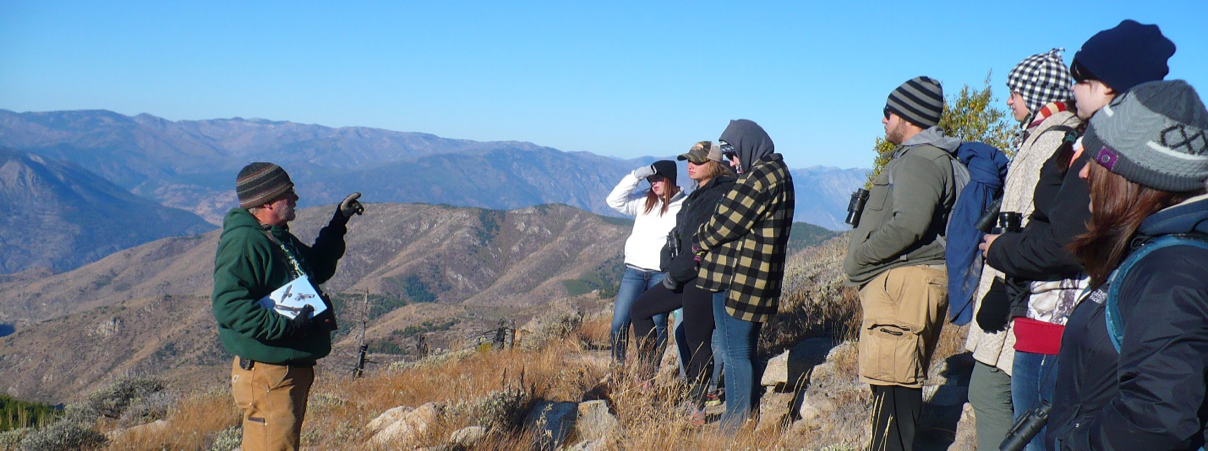
BS in Earth & Environmental Sciences
From earth science to ecology and from global climate change to environmental sustainability, School of the Environment (SOE) undergraduate students master scientific tools and practical skills to kickstart a meaningful career in a rapidly changing world.
The SOE experience does not stop at the doorway of the classroom or laboratory. Our students engage in research, outreach, professional societies, internships, and more to maximize their education.

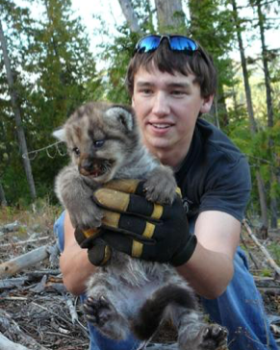
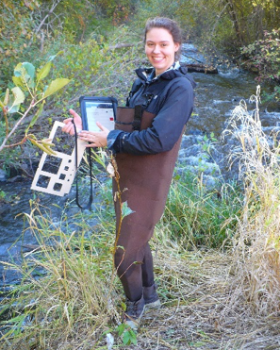
Our students can earn a bachelor of science degree in Earth and Environmental Sciences with a major in:
- Earth Science
- Environmental and Ecosystem Sciences
- Forest Ecology and Management
- Wildlife Ecology and Conservation Sciences
- Pre-veterinary Option
Our students may also earn a minor in:
- Forestry
- Environmental and Ecosystem Sciences
- Earth Science/Geology
- Natural Resource Science
- Wildlife Ecology
- Geospatial
Contact Academic Advisor
Pullman students
Alecia Hoene
509-335-6166
alecia.hoene@wsu.edu
Tri Cities students
Paisleigh Kelley
509-372-7241
paisleigh.kelley@tricity.wsu.edu
Elsa Silva Lopez
509-372-7490
esilva-lopez@tricity.wsu.edu
Vancouver students
Erin Leverman
360-546-9451
erin.leverman@wsu.edu
General Graduation Requirement:
- University Common Requirements (UCORE), Writing Portfolio/Qualifying Exam, and Capstone Course
- Foundation of basic science (biology, chemistry, and/or physics) and math courses
- Integrated Earth and Environmental Science Common Core (19 – 20 credits)
- Earth Systems (SOE 210 or SOE 250)
- Water Science (SOE 315 or SOE 460)
- Ecology (SOE 300 or BIOL 372)
- Society & Environment (SOE 312 or POL SCI 430)
- Spatial Analysis (SOIL SCI 368)
- Integrated Capstone (SOE 454 or SOE 408)
- Experiential Elective or milestone
- Major Core requirements
- Professional electives