The M.S. degree is an interdisciplinary program offering the flexibility for elective classes in the student’s desired area of specialization. Areas of focus typically include wildlife ecology and endangered species conservation; spatial and ecological relationships of plants and animals in terrestrial and aquatic ecosystems, in-stream physical and biological processes, and vertebrate and invertebrate ecology of wetland, lake, estuarine, and marine systems, modeling and dynamics of ecological and environmental systems, population ecology and modeling, sustainable resource management including water resources, private land management, and analysis of policy impacts and the human dimensions of resource conservation.
The M.S. in ENRS offers a choice of two degree plans available at any WSU campus or Extension/Research Center where SOE graduate faculty are located.
- The “Directed Studies” Plan is designed to provide maximum flexibility for faculty and graduate students to take advantage of the wide variety of disciplinary areas, campuses, and research centers included in SOE. This plan has minimal specific requirements (i.e. ,1 credit of SOE 501 Graduate Skills Seminar), so that it may be tailored to meet the needs of individual students, and take advantage of a wide variety of coursework from within and outside of SOE. Specific courses are selected in consultation with the thesis advisor and graduate committee.
- The “Interdisciplinary” Plan requires students to choose courses within distinct content areas, in addition to the required graduate seminar, to provide a general and well-rounded program in environmental and natural resource sciences, with the intent of l increasing interdisciplinary understanding and building cohorts of graduate students.
In addition to the two plans, students may choose between the thesis and non-thesis option. For the thesis option, students complete a research project that results in a publishable product. Students selecting the non-thesis option will complete a smaller project and take more course credits.
If you are interested in pursuing an M.S. in ENRS in SOE and being mentored by one of our faculty members, begin by first visiting their website and contacting them directly.
Your First Step
Explore our faculty research websites to learn about their work and how it aligns with your interests. Begin your graduate studies journey by contacting faculty directly—they are waiting to hear from you!
Multi-campus Program
- WSU-Vancouver
- WSU-Tri-Cities
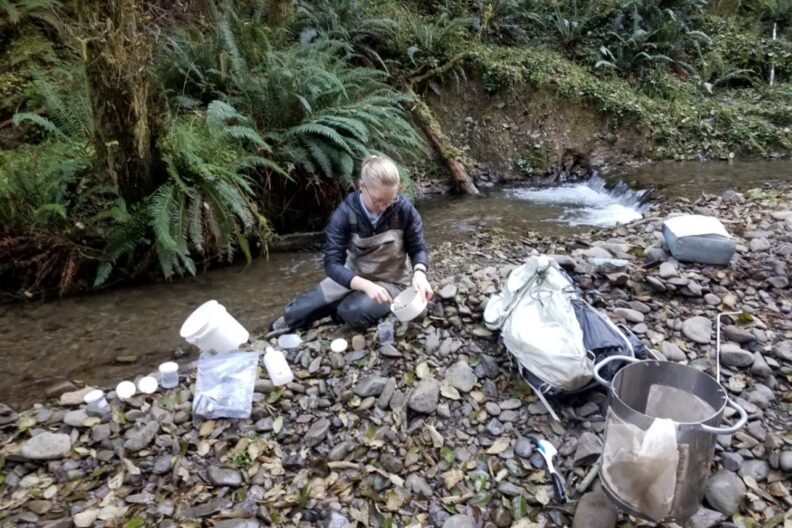
Courtesy of Elsa Toskey
Program Requirements
Directed M.S. in Environmental & Natural Resource Sciences
- At least 30 hours of total credits, consisting of:
- At least 21 credits of graded course work including:
- At least 15 credits of graded course work at the 500-level
- Not more than 6 credits of 300-400 level graded course work
- 1 hour of SOE 501 — Graduate Skills Seminar (not graded)
- 4 hours minimum of SOE 700 (Master’s research, thesis, and/or evaluation), 2 of which must be taken in the semester of the final exam (not graded)
- Courses taken for audit may not be used on the program of study
- At least 21 credits of graded course work including:
- Thesis
- Final oral exam — thesis defense
- At least 33 hours of graded & ungraded credits, consisting of:
- At least 26 hours of graded course work, including:
- At least 20 hours of graded course work at the 500 level
- Not more than 9 hours maximum of non- graduate graded course work at the 300 and 400 levels only.
- 1 credit of SOE 501 – Graduate skills seminar (not graded)
- At least 4 hours minimum of SOE 702 (Master’s special project, directed study or examination), 2 of which must be taken in the semester of the final exam (not graded)
- Courses taken for audit may not be used on the program of study
- At least 26 hours of graded course work, including:
- Also Required:
- Professional paper*
- Oral exam and committee ballot**
- * Professional paper is at discretion of the committee, but must be a substantive written product. Some examples of professional papers include (but are not limited to): reports for agencies or NGOs, a thesis-like research paper that is smaller in scope than a traditional thesis, a literature review paper, an analysis of a dataset along with a write-up of methods and interpretation of results.
- ** Oral exam will include a short presentation (~ 15 minutes) of the professional paper to the committee, followed by a discussion (~ 45 minutes). Committee will ballot at the end of this period.
Interdisciplinary Studies Plan M.S. Environmental & Natural Resource Sciences
- At least 30 hours of total credits, consisting of:
- At least 21 hours of graded course work including:
- At least 15 hours minimum of graded course work at the 500-level, including:
- 2 hours of SOE 592 or 597 (Advanced Topics)
- 3 hours of SOE 544 (Environmental Assessment) or other policy/society/management course
- 3 hours of statistics, math or other quantitative course work
- 13 hours of additional graded course work
- At least 8 hours of graded courses must be SOE prefix
- No more than 6 hours 300-400 level graded course work
- At least 15 hours minimum of graded course work at the 500-level, including:
- 1 credit of SOE 501 – Graduate Skills Seminar (not graded)
- 2 credits of SOE 598 (Seminar, not graded)
- 6 credits minimum of SOE 700 (Master’s research, thesis, and/or evaluation), 2 of which must be taken in the semester of the final exam (not graded)
- Courses taken for audit may not be used on the program of study
- At least 21 hours of graded course work including:
- Thesis
- Final oral exam — thesis defense
- At least 33 hours of total credits, consisting of:
- At least 26 hours of graded course work, including:
- At least 20 hours of graded course work at the 500-level, including
- 2 credits of SOE 592 or 597 (Advanced Topics)
- 3 credits of SOE 544 (Environmental Assessment), or other policy/society/management course
- 3 credits of statistics or math courses
- 18 credits of additional graded course work
- At least 6 credits of graded courses must be SOE pre-fix
- Not more than 9 hours maximum of non-graduate (300-400 level) graded course work
- At least 20 hours of graded course work at the 500-level, including
- 1 credit of SOE 501– Graduate skills seminar (not graded)
- 2 credits of SOE 598 –Seminar (not graded)
- At least 4 credits minimum of SOE 702 (Master’s special project, directed study or examination), 2 of which must be taken in the semester of the final exam (not graded).
- Courses taken for audit may not be used on the program of study
- At least 26 hours of graded course work, including:
- Also Required:
- Professional paper*
- Oral exam and committee ballot**
- * Professional paper is at discretion of the committee, but must be a substantive written product. Some examples of professional papers include (but are not limited to): reports for agencies or NGOs, a thesis-like research paper that is smaller in scope than a traditional thesis, a literature review paper, an analysis of a dataset along with a write-up of methods and interpretation of results.
- ** Oral exam will include a short presentation (~ 15 minutes) of the professional paper to the committee, followed by a discussion (~ 45 minutes). Committee will ballot at the end of this period.