Graduate Student Handbook, School of the Environment
Graduate Degrees
The School of the Environment offers several degree programs that cover a broad range of Earth & environmental sciences.
The SOE currently offers two (2) Master of Science (MS) degree programs:
- MS in Geology (Pullman)
- Thesis-track only
- MS in Environmental & Natural Resource Sciences
- Thesis-track Directed Study Plan
- Non-thesis-track directed study plan
- Thesis-track interdisciplinary plan
- Non-thesis-track interdisciplinary plan
The SOE currently offers two (2) PhD degree programs:
- PhD Environmental & Natural Resources
- PhD Geology
Master of Science Degrees
Descriptions of both MS degrees are provided in the next section. Students are expected to complete MS degree requirements within two years (full-time enrollment, with assistantship), with options for extension as outlined in the Academic Regulations, Policies and Procedures section of the handbook.
Generalized timeline for SOE MS degrees:
1st year – Fall
- Take coursework
- Assemble thesis committee
1st year – Spring
- Committee meeting
- File program of study
- Continue coursework
- Begin research
Summer
- Continue research
2nd year – Fall
- Complete coursework
- Complete data analysis
2nd year – Spring
- Write and defend thesis
- Graduate
Master of Science in Geology
The primary goal of the Master of Science in Geology. program at WSU is to prepare students for professional employment in a broad range of geoscience careers (e.g., environmental consulting, minerals/petroleum industry, local/state/federal resource-based or management agencies, teaching), or for serving as a foundation for continuing to graduate studies at the PhD level. WSU offers specialization in multiple subdisciplines, including structure/tectonics, petrology, geochemistry, geophysics/geodynamics, and sedimentology/stratigraphy.
The goal of the MS program is to produce broadly trained, professional geoscientists with the ability to conduct original scientific research. In addition to course work, the primary requirement for the MS degree is preparation of a thesis that should represent a publishable contribution to the geoscience community. Each program is designed in consultation with a faculty advisor to meet the needs of the student.
MS Geology (Thesis option only) Academic Requirements
- At least 30 hours total of graded and ungraded coursework
- At least 21 hours of graded coursework, including:
- At least 15 hours minimum of graded course work at the 500 level
- Up to 6 hours maximum non-graduate graded coursework is allowed at the 300-400 levels only.
- SOE 501 (Graduate Skills Seminar, 1 credit hour) must be taken during the first year of the program (not graded)
- 4 hours minimum of SOE 700 (MS research, thesis or examination), 2 hours of which must be taken in the semester of the final exam (not graded).
- Courses taken for audit may not be used on the program of study.
- Written Thesis
- Final oral exam: Thesis defense
MS in Environment & Natural Resource Sciences
The Environmental & Natural Resource Sciences Master of Science (MS-ENRS) program focuses on fundamental questions in Environmental Sciences and Natural Resource Sciences ranging from how to conserve the diversity of global, national, and local species, how micro- and macro-ecologies function with one another, how water, soil, and other natural resource systems impact environments and human society, and how we may best sustainably manage our abundant and diverse natural resources.
Some areas of specialization include:
- Ecology and conservation of wildlife and habitats
- Ecology of aquatic and terrestrial ecosystems
- Ecohydrology and biogeochemistry
- Quantitative modeling and spatial ecology, including remote sensing
SOE offers thesis and non-thesis tracks in Environmental & Natural Resource Sciences, with a directed studies plan and interdisciplinary studies plan for both.
For students pursuing the Environmental & Natural Resource Sciences thesis option, the goal is a publishable contribution to environmental and natural resource science.
Students pursuing the non-thesis option produce a project rather than a thesis and must complete more graded course credits.
Students should discuss which options are right for them with their advisors.
M.S. in Environmental & Natural Resource Sciences (Thesis- track, Directed Studies Plan)
WSU campuses with a program
Academic requirements
- At least 30 hours of graded and ungraded credits, consisting of:
- At least 21 hours of graded coursework
- At least 15 hours of graded coursework at the 500-level
- Not more than 6 hours of non-graduate graded coursework at the 300 and 400 levels only
- 1 hour of SOE 501 – graduate skills seminar (not graded)
- 4 hours minimum of SOE 700 (master’s research, thesis, and/or evaluation), 2 of which must be taken in the semester of the final exam (not graded)
- Courses taken for audit may not be used on the program of study
- At least 21 hours of graded coursework
- Written thesis
- Final oral exam (thesis defense)
M.S. in Environmental & Natural Resource Sciences (Thesis- track, Interdisciplinary Plan)
WSU campuses with a program
Academic requirements
- At least 30 hours of graded and ungraded credits, consisting of:
- At least 21 hours of graded course work
- At least 15 hours minimum of graded course work at the 500-level, with:
- 2 hours of SOE 592 or 597 (Advanced Topics)
- 3 hours of SOE 544 (Environmental Assessment) or other policy/society/management course
- 3 hours of statistics, math, or other quantitative coursework
- At least 8 hours of graded courses must be SOE prefix
- No more than 6 hours of non-graduate graded coursework at the 300-400 levels only
- 1 credit of SOE 501: Graduate Skills Seminar (not graded)
- 2 credits of SOE 598 (seminar, not graded)
- 6 credits minimum of SOE 700 (master’s research, thesis, and/or evaluation), 2 of which must be taken in the semester of the final exam (not graded)
- Courses taken for audit may not be used on the program of study
- Written thesis
- Final oral exam: thesis defense
M.S. in Environmental & Natural Resource Sciences (Non-thesis, Directed Studies Plan)
WSU campuses with a program
Academic requirements
- At least 33 hours of graded & ungraded credits, consisting of:
- At least 26 hours of graded course work, including:
- At least 20 hours of graded course work at the 500 level
- Not more than 9 hours maximum of non- graduate graded course work at the 300 and 400 levels only.
- 1 credit of SOE 501 – Graduate skills seminar (not graded)
- At least 4 hours minimum of SOE 702 (Master’s special project, directed study or examination), 2 of which must be taken in the semester of the final exam (not graded)
- Courses taken for audit may not be used on the program of study
- At least 26 hours of graded course work, including:
- Professional paper*
- Oral exam and committee ballot**
* Professional paper is at discretion of the committee, but must be a substantive written product. Some examples of professional papers include (but are not limited to): reports for agencies or NGOs, a thesis-like research paper that is smaller in scope than a traditional thesis, a literature review paper, an analysis of a dataset along with a write-up of methods and interpretation of results.
** Oral exam will include a short presentation (~ 15 minutes) of the professional paper to the committee, followed by a discussion (~ 45 minutes). Committee will ballot at the end of this period.
M.S. in Environmental & Natural Resource Sciences (Non-thesis, Interdisciplinary Plan)
WSU campuses with a program
Academic requirements
- At least 33 hours of total credits, consisting of:
- At least 26 hours of graded course work, including:
- At least 20 hours of graded course work at the 500-level, including
- 2 credits of SOE 592 or 597 (Advanced Topics)
- 3 credits of SOE 544 (Environmental Assessment), or other policy/society/management course
- 3 credits of statistics or math courses
- 18 credits of additional graded course work
- At least 6 credits of graded courses must be SOE pre-fix
- Not more than 9 hours maximum of non-graduate (300-400 level) graded course work
- At least 20 hours of graded course work at the 500-level, including
- 1 credit of SOE 501– Graduate skills seminar (not graded)
- 2 credits of SOE 598 –Seminar (not graded)
- At least 4 credits minimum of SOE 702 (Master’s special project, directed study or examination), 2 of which must be taken in the semester of the final exam (not graded).
- Courses taken for audit may not be used on the program of study
- At least 26 hours of graded course work, including:
- Professional paper*
- Oral exam and committee ballot**
* Professional paper is at discretion of the committee, but must be a substantive written product. Some examples of professional papers include (but are not limited to): reports for agencies or NGOs, a thesis-like research paper that is smaller in scope than a traditional thesis, a literature review paper, an analysis of a dataset along with a write-up of methods and interpretation of results.
** Oral exam will include a short presentation (~ 15 minutes) of the professional paper to the committee, followed by a discussion (~ 45 minutes). Committee will ballot at the end of this period.
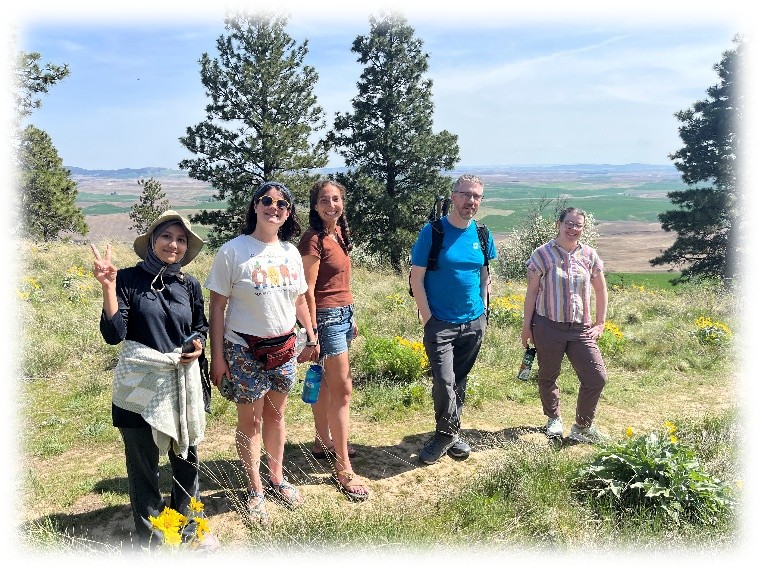
Students on a hike overlooking the Palouse hills
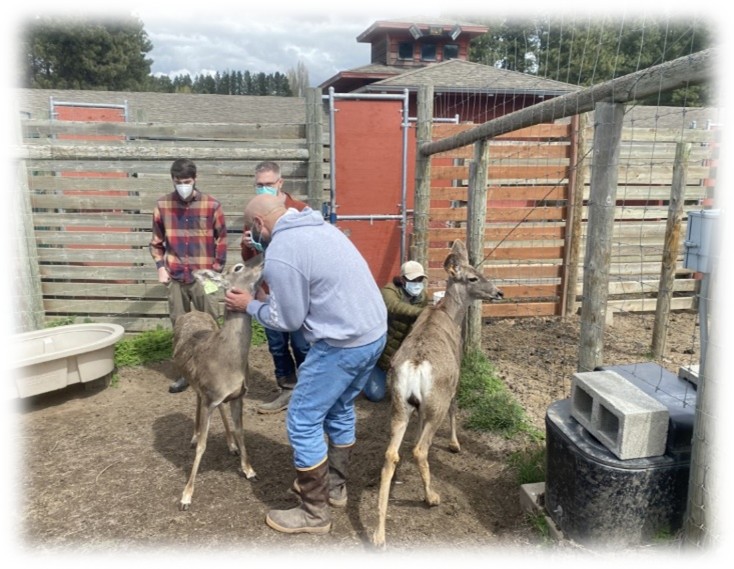
Students working with deer
Doctoral degrees offered
The following is a timeline offered as a guide to the timely completion of the Ph.D. degrees. Note the total duration of any individual’s doctoral program will vary depending on prior degrees earned, the student’s research topics, and specific methodological approaches.
The guide below is typical of a PhD student who entered the program having already earned a M.S. in a related field. Please note some students’ time to degree may vary by 1-2 years based on the scope of the student’s project, however, all WSU graduate students must finish within four years of passing their prelims, per graduate school policy.
Generalized Timeline for PhD Programs:
1st Year – Fall
- Assemble dissertation committee
1st year – Spring
- Committee meeting
- Continue coursework
- Begin research
- File program of study
1st Summer
- Continue research
2nd year – Fall
- Continue coursework
- Continue research
- Committee meeting
2nd year – Spring
- Finish coursework
- Complete research proposal
- Prepare for and complete preliminary examination
2nd Summer
- Continue research
3rd year – Fall
- Continue research
- Committee meeting
- Begin data analysis
3rd year – Spring
- Continue research
- Continue data analysis
3rd Summer
- Continue research
- Continue data analysis
4th year – Fall
- Complete data analysis
- Begin writing
4th year – Spring
- Complete writing
- Defend dissertation
PhD in Geology
The Geology PhD program’s main goal at WSU is to train students to be independent researchers and/or educators and to bring them to the forefront of a specialized geoscience subdiscipline. PhD graduates are expected to have demonstrated the ability to conduct independent research and should have the level and breadth of knowledge that one could expect of someone who has attained the highest academic degree in their field. PhD Graduates of the PhD program are regularly employed in specialized geoscience careers, including college-level teaching and/or research, resource industries, or state federal resource and management agencies.
Research performance, as demonstrated by preparation of a dissertation on an independently pursued research topic, is the primary requirement for the PhD degree. The dissertation is expected to be a significant advance forward in solving scientific problems specific to the student’s chosen subdiscipline, and often consists of multiple publishable chapters. Each program is designed with a faculty advisor to meet the student’s needs.
The SOE offers specialization in multiple geology subdisciplines, including:
- Structure/tectonics
- Petrology
- Geochemistry
- Geophysics/geodynamics
- Sedimentology/stratigraphy
PhD in Geology program
Campuses offering PhD in Geology
Academic requirements
- 72 hours minimum graded and ungraded credits, consisting of:
- 15 hours minimum of graded WSU course work at 500 level if student has an MS
- All 15 hours must be completed at WSU
- 24 hours minimum of graded coursework if student has only a BS
- Of these 24, 15 minimum must be taken at the 500 level at WSU
- A maximum of 9 credits of 300 or 400 may be taken toward the 24 required credit hours
- SOE 501 Graduate Skills Seminar, not graded
- 20 hours minimum of SOE 800 – 1 credit during each semester enrolled except summer.
- Courses taken for audit or courses graded Pass/Fail may not be used on the program of study.
- 15 hours minimum of graded WSU course work at 500 level if student has an MS
- Preliminary exam
- Written dissertation
- Final oral exam: Dissertation defense
PhD in Environmental & Natural Resource Sciences
Doctoral research in Environmental and Natural Resource Sciences (ENRS) spans a range of biological, physical, and social sciences that focus on understanding and managing the environment, including diverse aquatic and terrestrial ecosystems and natural resources such as plants and animal.
The PhD dissertation should be a significant contribution worthy of publication in refereed international journals. Specializations are offered in the areas such as:
- Environmental policy and management
- Aquatic ecology, forest ecology
- Wildlife ecology, conservation, and biodiversity
- Quantitative and spatial aspects of natural resources
Program Core Competencies and Student Outcomes for PhD in ENRS
The PhD program in ENRS is designed to educate, train and mentor students in six core competency areas within Environmental and Natural Resource sciences. Those include:
- Advanced knowledge of ecosystems, including biotic and abiotic structure and function, the roles of humans and societies, and applications to management
- Advanced knowledge in research methods and data analysis, including aptitude for assessing a wide range of environmental and/or social science data.
- Ability to critically examine and creatively address interdisciplinary problems.
- Advanced knowledge in the ethics of managing and conducting research in the environmental and natural resource sciences, actively incorporating issues of environmental and social justice, equity, and inclusion.
- Ability to effectively communicate knowledge of environmental and natural resource sciences to a wide range of audiences, through multiple modes of delivery, including written and oral formats.
- A specialized subject area to be defined by the student and the student’s Supervisory Committee.
By pursuing competence in these areas, students who successfully complete the PhD in ENRS will be able to:
- Attain expertise in core disciplinary areas and understanding of interdisciplinary approaches.
- Recognize, think critically about, and develop creative solutions to scientific problems.
- Become effective teachers in field, laboratory, and lecture-room settings.
- Master the field, lab, analytical, and theoretical skills necessary to perform the research.
- Effectively communicate the results of their research.
- Write successful research grant proposals or otherwise obtain research funding.
- Prepare future students to successfully compete for jobs.
- Contribute scientific leadership and expertise at the local, state, and national levels.
- Become visible members of the scientific community by taking organizational and service roles.
PhD in Environmental & Natural Resource Sciences programs
Campuses offering program
Academic requirements
- 72 hours minimum graded and ungraded credits, consisting of:
- 15 hours minimum of graded WSU course work at 500 level if student has an M.S.
- All 15 hours must be completed at WSU
- 24 hours minimum of graded coursework if student has only a B.S.
- Of these 24, 15 minimum must be taken at the 500 level at WSU
- A maximum of 9 credits of 300 or 400 may be taken toward the 24 required credit hours
- SOE 501 Graduate Skills Seminar, not graded
- 20 hours minimum of SOE 800 – 1 credit during each semester enrolled except summer.
- Courses taken for audit or courses graded Pass/Fail may not be used on the program of study.
- 15 hours minimum of graded WSU course work at 500 level if student has an M.S.
- Preliminary exam
- Written Dissertation
- Final oral exam: Dissertation defense